This brief is adapted from a report produced with Accenture and Tech:NYC. Read the full analysis here.
AI is creating a new generation of businesses in New York City while changing how its established industries operate. The startups selling into banks, insurers and health systems offer an early view of what that shift could mean for the city’s economy, from the work being automated to the jobs being created.
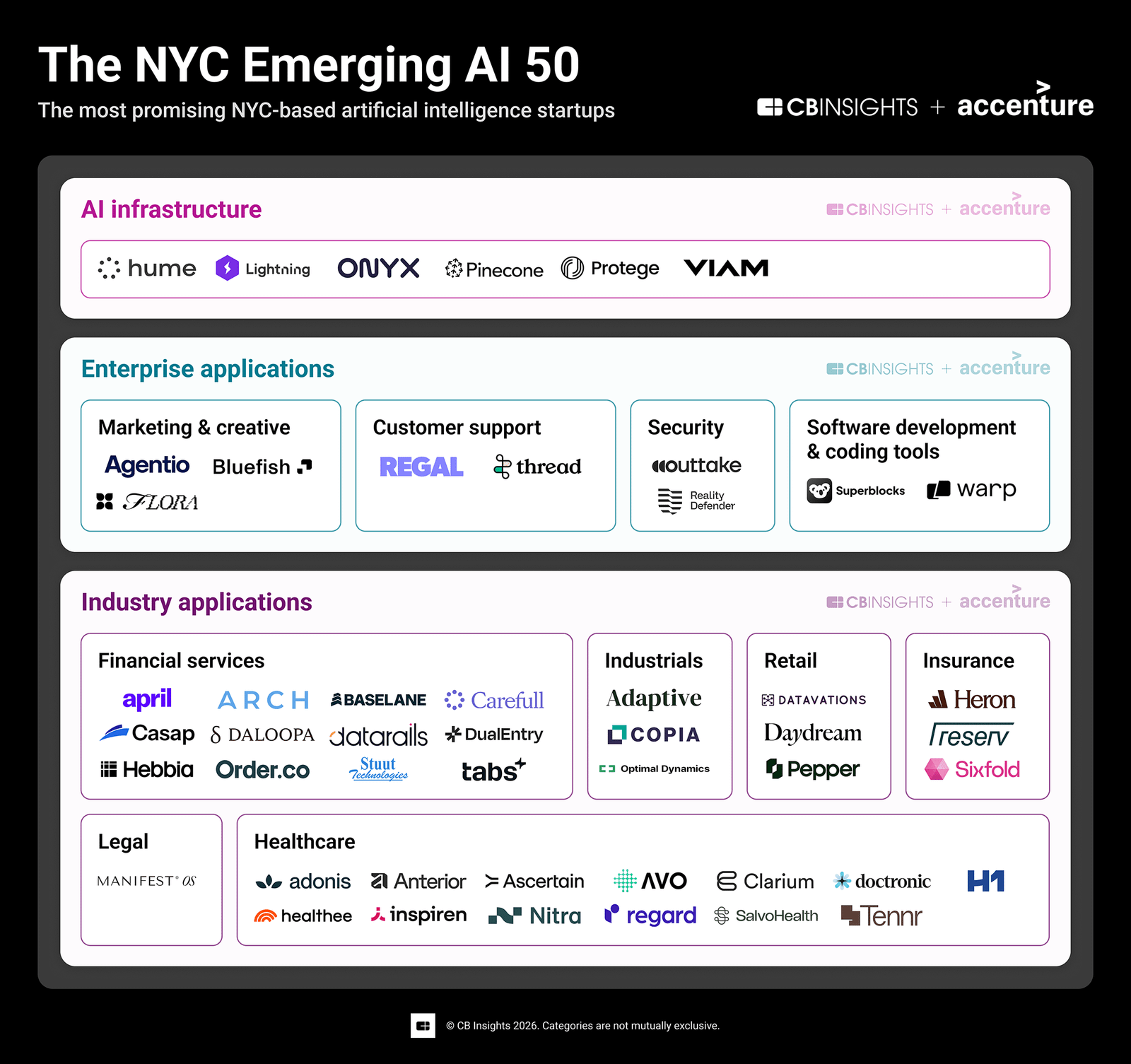
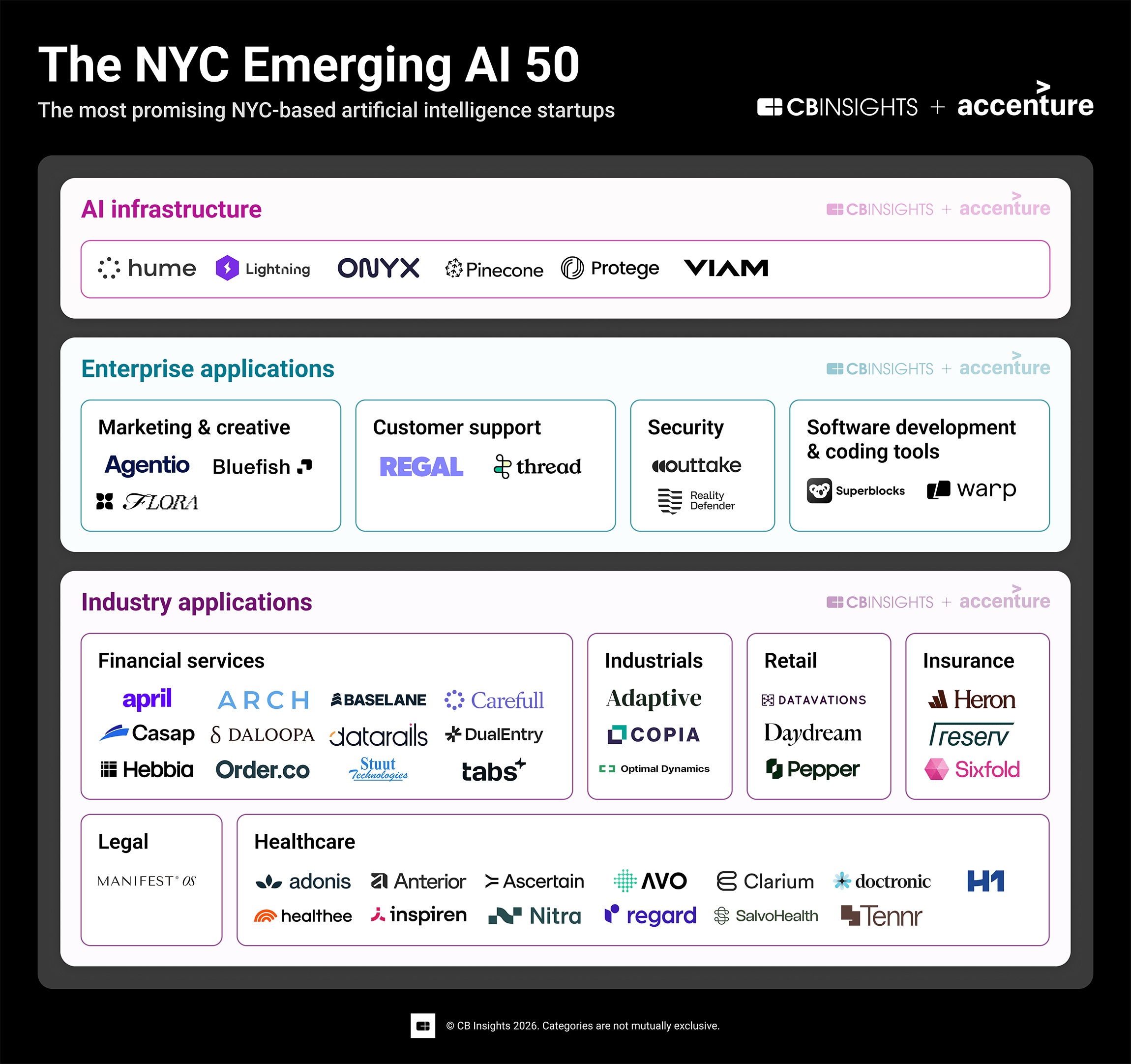
The NYC Emerging AI 50 puts 50 of the city’s most promising AI startups in focus. Together, they employ roughly 8,000 people and added approximately 2,450 net jobs over the past year.
Our analysis begins by examining the broader ecosystem around them: where NYC’s venture-backed AI companies are being built, where capital is concentrating and which businesses have reached unicorn scale. We then return to the NYC Emerging AI 50 for a closer look at their sectors, customers and hiring.
New York City’s AI ecosystem
New York City’s five boroughs are home to over 2,000 venture-backed AI companies that have raised a combined $78.5 billion and employ roughly 187,000 people. That makes NYC the second-largest AI hub in the country, behind San Francisco.
The two hubs are structured differently. San Francisco’s capital base is concentrated in a single company: OpenAI accounts for 37% of all Bay Area AI funding. NYC’s is distributed. Its largest player, Ramp, represents under 5% of the city’s total.
NYC’s AI companies also sit at a different layer of the stack. Rather than training frontier models, they sell AI into the banks, insurers, health systems and asset managers that already anchor the city’s economy. The city’s clearest AI advantage is emerging where the technology meets the expensive, specialized knowledge work its incumbent industries already run on. That pattern holds across the ecosystem, in what gets founded, in what reaches $1 billion and in who is adding headcount.
The ecosystem is young and broad. The median company was founded in 2021, and nearly two-thirds have been founded since 2020. Most companies are small: The median employs 19 people and has raised $9 million, sitting beneath a small set of large, established players.
The composition of that base shows where AI is being commercialized. The largest subindustries are applied and back-office rather than horizontal tooling:
- Business intelligence and analytics: 205 companies
- Accounting and finance: 149 companies
- Healthcare: 144 companies
- Advertising and sales tech: 122 companies
- Monitoring and security: 112 companies
- Application and data integration: 110 companies
Finance sits at the center of that mix. Accounting and finance plus asset and financial management together form one of the largest applied clusters, mirroring the industries that define NYC’s economy. It is also where formation most clearly converts into scale: Asset and financial management produces unicorns at more than twice the ecosystem rate, with six unicorns among its 74 companies.
Financial-services AI companies in NYC are more likely than average to break out. Finance is not only the city’s largest AI specialization; it is the clearest evidence that its industry density translates into breakout companies.
Investors are organizing around those same verticals, as they mirror the ecosystem’s applied tilt on the supply side, with sector-specialist vehicles clustering in NYC’s strongest markets:
- Viola FinTech: 40 NYC AI portfolio companies
- Plug and Play: 28 through its fintech accelerator, 22 through insurtech
- Techstars: 69 through its healthcare program, 23 through lifetech
Funding no longer predicts growth
The ecosystem has added an estimated 26,000 net jobs over the past year, but that growth is unevenly distributed. Of roughly 1,900 companies with disclosed headcount, about half grew, a quarter held flat and a quarter shrank, leaving the median company essentially flat. How little that outcome depends on money raised is the notable part. A comparable 26% of companies contracted whether they had raised under $5 million or between $100 million and $500 million. Raising $100 million does not make a company meaningfully less likely to be shrinking than raising $5 million. Funding still marks who has attracted capital, but it says less about which companies are gaining operating momentum, which is why the 50-company cohort below is screened on momentum rather than on capital raised.
Where the capital sits
Capital is far more concentrated than hiring. The 59 largest companies, 3% of the ecosystem, hold roughly half of all money raised by AI companies in NYC. What sets that tier apart is age and maturity. They are older (median founded 2016 versus 2021 ecosystem-wide), later-stage (81% at Series B or beyond versus roughly 13% across the ecosystem) and larger, at a median headcount of 556. Forty-nine of the 59 are already unicorns. The top of the list blends fintech, data infrastructure and generative media.
From a geographic perspective, two names pop up as the hotbed for AI: San Francisco holds more companies and far more capital. NYC’s high concentration of the regulated, applied verticals contrasts to San Francisco’s concentration in infrastructure and robotics. NYC carries roughly 1.7 times San Francisco’s share in accounting and finance, nearly 3 times in asset and financial management and leads in healthcare and real estate; San Francisco nearly doubles NYC’s share in application and data integration and leads in robotics. The gap is also narrower than the totals imply. The median NYC AI company has raised more than its San Francisco counterpart, $9 million versus $5.5 million.
Largest NYC AI companies by total funding
| Company | Funding ($M) | Valuation ($M) | Borough | Latest round |
|---|---|---|---|---|
| Ramp | 3,582 | 44,000 | Manhattan | Series F |
| Cyera | 2,300 | 12,000 | Manhattan | Series G |
| Reflection | 2,130 | 8,000 | Brooklyn | Series B |
| AlphaSense | 1,747 | 7,500 | Manhattan | Series G |
| Optimizely | 1,157 | 1,100 | Manhattan | Debt |
| Dataminr | 1,144 | 4,100 | Manhattan | Convertible Note II |
| Grafana Labs | 1,090 | 6,170 | Manhattan | Series E |
| Ro | 1,027 | 7,000 | Manhattan | Series D II |
| Claroty | 882 | 3,000 | Manhattan | Series F |
| VAST Data | 881 | 30,000 | Manhattan | Series F |
Borough and latest-round detail as of August 2026.
Share of AI companies by sub-industry: NYC vs. San Francisco
| Sub-industry | NYC share | SF share |
|---|---|---|
| Finance | 10.6% | 5.2% |
| Healthcare | 6.9% | 5.4% |
| Real Estate | 2.3% | 1.2% |
| Application & Data Integration | 5.3% | 10.0% |
| Robotics | 0.9% | 2.4% |
| HR & Workforce Management | 2.8% | 3.7% |
| Data & Document Management | 2.1% | 2.9% |
The 74 AI unicorns
New York City is now home to 74 AI unicorns, second only to San Francisco (151) among major US hubs and nearly three times Boston’s 27. They are 3.5% of the city’s AI companies but carry outsized weight: roughly $39 billion raised, close to half of all capital deployed in the ecosystem, and about 34% of its headcount, some 63,600 employees.
They are also the companies scaling payroll. The median unicorn employs 490 people against an ecosystem median of 19, and 56 of the 74 grew headcount over the past year while the median company across the ecosystem was flat.
Unicorn-scale value concentrates around NYC’s core industries, and finance leads. Finance-focused companies have produced 10 of the 74, more than any other industry, alongside a deep bench of scaled players from Ramp and AlphaSense to Addepar and Chainalysis. The newest of them target the work finance teams do themselves: research, accounting, FP&A, accounts receivable and payable, underwriting and investment analysis.
Beyond finance, the winners cluster in a few data-heavy niches, with monitoring and security producing the most of any single sub-industry (nine) and business intelligence and analytics next (eight).
Largest valuation marks
| Company | Valuation ($M) |
|---|---|
| Ramp | 44,000 |
| VAST Data | 30,000 |
| Cyera | 12,000 |
| ElevenLabs | 11,000 |
| Chainalysis | 8,600 |
NYC AI unicorns by sub-industry
| Sub-industry | Unicorns |
|---|---|
| Finance | 10 |
| Monitoring & Security | 9 |
| Business Intelligence & Analytics | 8 |
| Healthcare | 6 |
| Asset & Financial Management & Trading | 6 |
| Customer Relationship Management | 6 |
Unicorn creation is accelerating
NYC minted 15 new AI unicorns in 2026 through August, up from seven in all of 2025. Companies founded as recently as 2025, among them Flourish AI ($2.5 billion) and General Intuition ($2.3 billion), reached billion-dollar valuations within roughly a year of founding. The path to $1 billion is compressing more broadly, too: Companies that crossed the mark in 2025–2026 did so a median of five years from founding, against seven for those that reached it before 2023.
A handful of investors consistently beat the field in picking them. Against an ecosystem base rate of 3.5%:
- Tiger Global and Sequoia: roughly 38% of their NYC AI bets each
- Khosla Ventures: 31%
- Lux Capital: 26%
- Bessemer: 21%
- BoxGroup: 11 unicorns from 55 seed-stage bets (20%)
Those rates partly reflect late-stage crossover money piling into companies that had already broken out. BoxGroup’s seed-stage record is the clearest case of early conviction in the NYC ecosystem.
The largest unicorns are wiring themselves into NYC’s core institutions:
- Ramp: 171 tracked business relationships, including Visa, Microsoft and OpenAI.
- Chainalysis: 176 relationships, including PayPal, Google and Meta.
- Maven Clinic and Spring Health: embedded into employers, insurers and health plans including Amazon, Aetna and Workday.
These companies are not selling to each other. They are embedding into the banks, insurers, payment networks and health systems that anchor the city’s economy.
Inside the NYC Emerging AI 50
Collectively, the 50 have raised $4.3 billion in funding, roughly 5% of the city’s AI capital. These companies create value at the application and deployment layer rather than in the underlying model infrastructure, and their customer lists follow the same industry pattern as the tier above them:
- Financial services and legal: Hebbia sells into investment banks and law firms such as Seyfarth Shaw; Arch and Carefull into wealth managers such as Edward Jones; Stuut into payments giant Fiserv.
- Insurance: Sixfold and Reserv sell into carriers including Munich Re and Skyward Specialty.
- Healthcare: Ascertain, Clarium and Tennr sell into health systems including Northwell Health and Community Health Network.
- Enterprise pull is concentrated in one name: deepfake detection startup Reality Defender alone accounts for 11 of the cohort’s Fortune 500 relationships, including JPMorgan Chase, IBM, Visa and Microsoft.
Net hires by company-size band
| Headcount band | Companies | Net hires added (1-Y) | % of net hires |
|---|---|---|---|
| 50–99 | 26 | 545 | 22% |
| 100–199 | 12 | 594 | 24% |
| 200–499 | 8 | 678 | 28% |
| 500+ | 4 | 629 | 26% |
The corporate capital behind the 50 is pointed in the same direction:
- Google Ventures is the most active corporate backer: Daydream, DualEntry, Tennr, Hebbia and Warp.
- Insurers Munich Re, Guidewire and Salesforce Ventures back underwriting-AI company Sixfold.
- Health systems and pharma: Novartis, CVS Health Ventures, Kaiser Permanente and Northwell back H1, Clarium and Ascertain.
The deepest strategic benches sit with companies selling into regulated incumbents, a sign that those incumbents are investing where they may also intend to buy.
Sector mix and hiring
The cohort is overwhelmingly industry applications: AI built for a specific sector rather than horizontal tooling. Thirty-five of the 50 fall here, led by healthcare (13 companies) and financial services (12), with smaller clusters in insurance, industrials and retail (three each). The remaining 15 are split between enterprise applications (nine across marketing and creative, customer support, security and coding tools) and AI infrastructure (six).
Industry applications also drive the hiring: they account for 1,788 of the cohort’s approximately 2,450 net hires (73%), led by financial services (+855) and healthcare (+559). Enterprise applications grew fastest by rate (median +82%, pulled up by marketing and creative names like FLORA and Bluefish), while AI infrastructure was essentially flat. NYC’s AI activity is concentrated in the regulated, datarich industries the city already leads.
The cohort employs nearly 8,000 people and added roughly 2,450 net hires over the past year, a 44% increase on prior-year headcount. Among companies with headcount above 100, the fastest growers were FLORA (+390%), Bluefish (+332%) and Lightning AI (+211%); only four companies contracted.
That growth is not a small-startup effect. Net hires are near-identical across every company-size band, so hiring holds as these companies scale.
The direct job creation is measurable, but it is the smaller effect. The larger prize is the productivity gains these companies enable across the finance, healthcare and insurance sectors they serve, which employ a far greater share of the city than the startups themselves.
NYC’s advantage is becoming more valuable as AI moves from experimentation into day-today business. The city already has the banks, insurers, health systems, asset managers and other large institutions that AI companies want as customers. The NYC Emerging AI 50 shows a group of startups beginning to grow alongside those industries, with hiring spread across companies of very different sizes.
What happens next will matter beyond the startup sector. If these companies continue to move into the core workflows of NYC’s largest industries, their economic impact will come from changing how far larger employers operate. The companies on this list are still early, but they offer a first look at where that change is already underway.
If you aren’t already a client, sign up for a free trial to learn more about our platform.