
Last week, Commure‘s autonomous coding product earned Epic Toolbox designation, a label its ambient AI scribe already held. A health system on Epic can now document a patient visit and assign medical billing codes without leaving the system.
Commure is adding software for other parts of a health system’s work, too. In June, the company launched Orchestrator to handle incoming patient referrals. It’s also hiring engineers for Air, its AI-native EHR platform. Alongside that product expansion, it started selling its ambient AI in Europe and the UK in September.
Fresh off a $70M Series F extension in May, Commure has the money to buy what it doesn’t build. And it’s bought its way into new products before: It took Nasdaq-listed Augmedix private in 2024 to expand its ambient documentation business, and Rx.Health became Commure Engage, its patient outreach product.
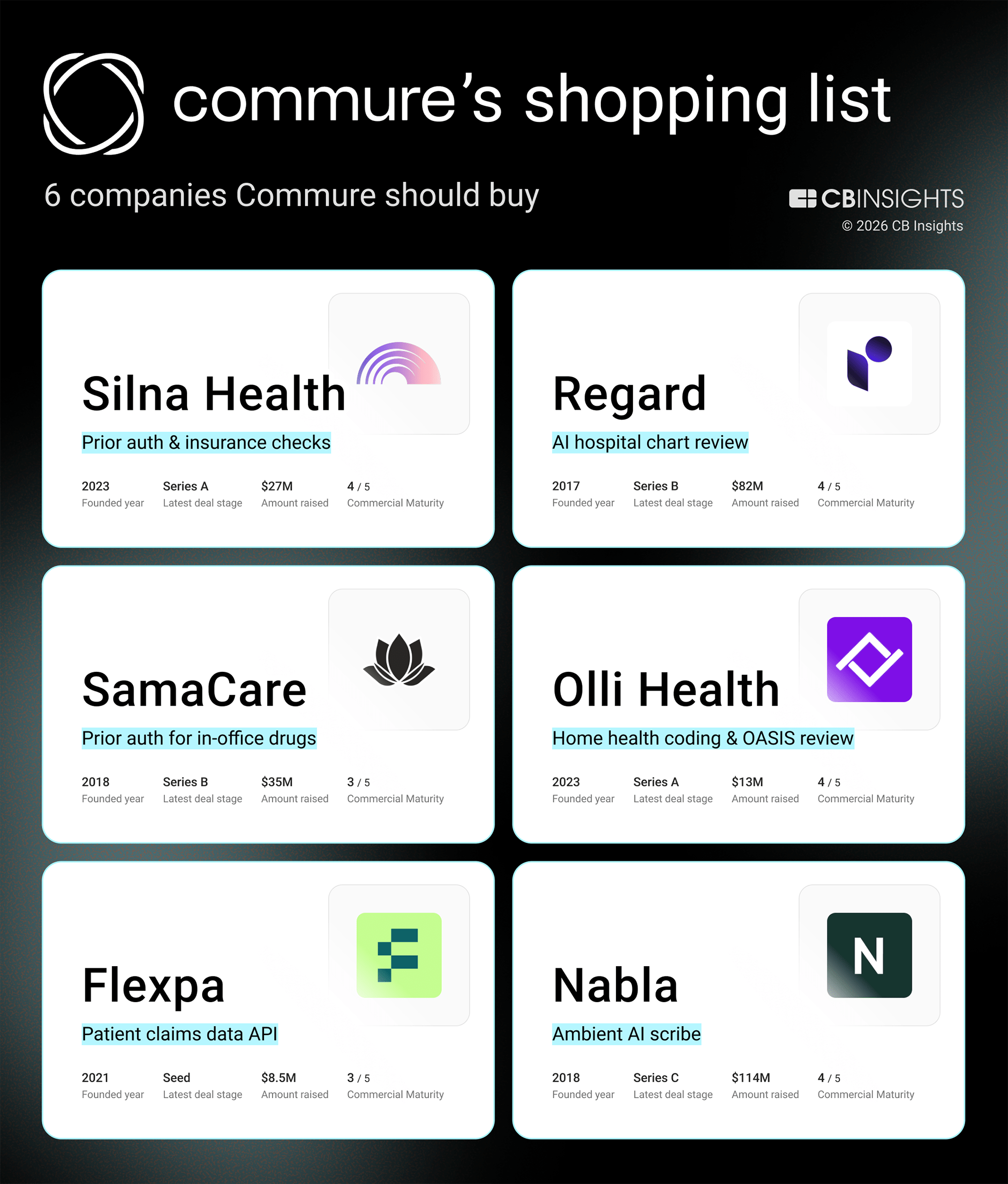
Based on its 7 past acquisitions, the company buys finished products with paying customers and sells them straight into the 500+ health systems and practices it already serves. Using CB Insights data, we mapped what’s missing as Commure builds out its healthcare software suite and found 6 startups that would fill those gaps.
The gaps in Commure’s system
- Specialized prior authorization. Prior authorization holds up revenue before care even starts. Commure’s AI agents already handle some of it, but specialists go deeper on difficult cases, such as drugs given in the office and home health visits that insurers have to re-approve.
- Coding beyond the doctor’s office. Commure has recruited human coders for hospital stays, and Orchestrator is live across Compassus‘ home health programs.
- Patient data underneath it all. An EHR of its own needs patient and payer data flowing in from outside sources.
- A foothold in Europe. Commure launched its ambient AI in the EU and UK in September, which it said was “in response to significant demand.”
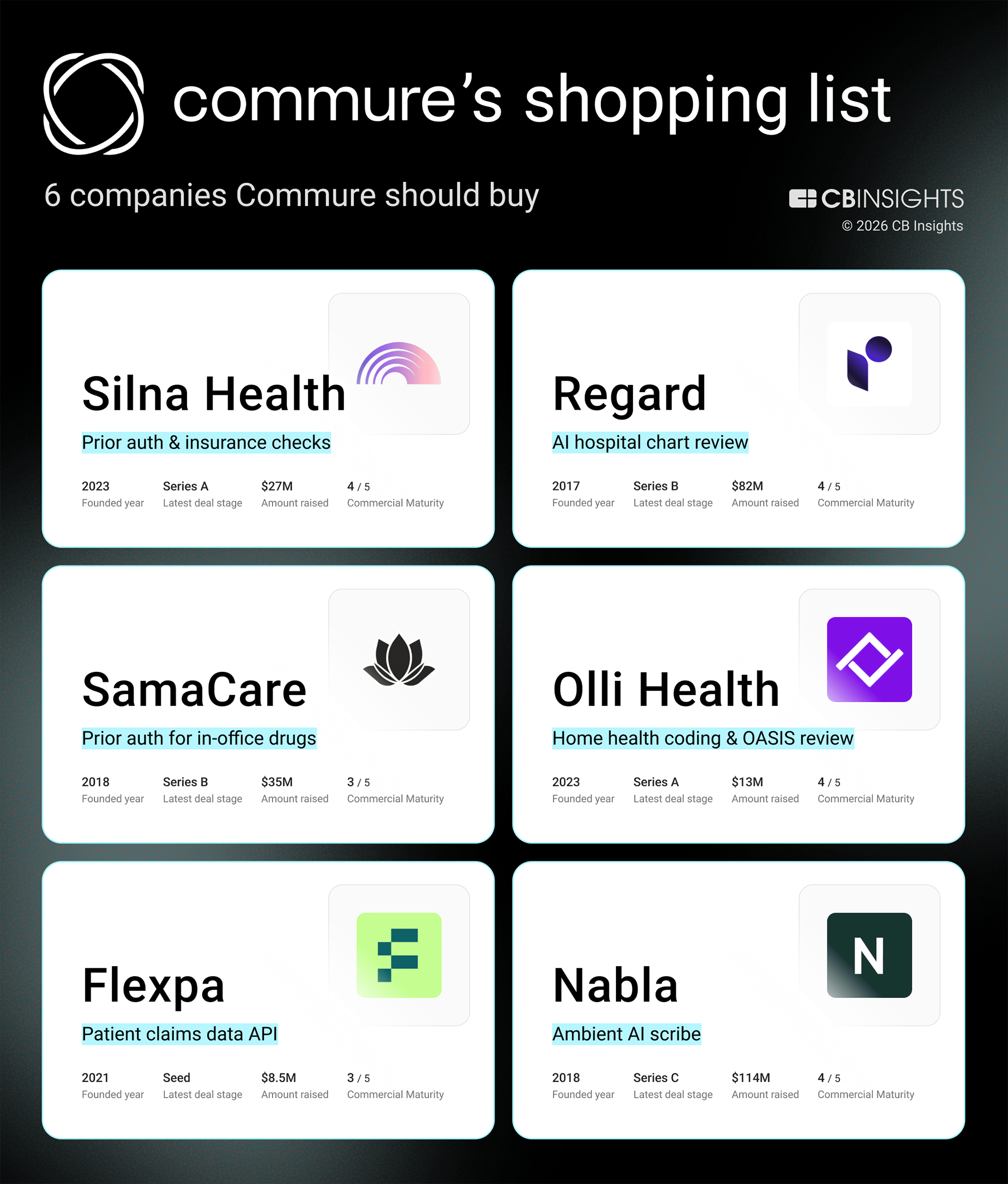
6 companies Commure should buy
- Silna Health handles prior authorization, benefit checks, and insurance monitoring for behavioral health, post-acute, and specialty providers.
- Why Silna: Commure’s Orchestrator checks a patient’s insurance when a referral comes in, but the paperwork doesn’t stop at admission. Home health insurers approve a set number of visits, so agencies have to keep re-authorizing (typically every 60 days) and catch any change in a patient’s coverage. Silna automates that work, which would keep Commure involved at Compassus’ home health programs for the full stay.
- Why now: Competitor R1 bought prior authorization startup Humata Health in August, and Zocdoc bought insurance verification startup Sohar Health this month. Silna hasn’t raised since its $22M Series A in March 2025 and entered its funding window in January, so Commure’s cheapest chance is before it raises again.
- Regard reads hospital patient charts and flags diagnoses missing from the documentation before the stay is coded.
- Why Regard: A missed diagnosis lowers what a hospital is paid for a stay. Regard would automate hospital coding, work Commure has previously recruited human coders to do.
- Why now: RCM companies are buying chart-review tools. Waystar acquired Iodine Software in July 2025, and Smarter Technologies acquired Pieces two months later. Regard, valued at $350M in 2024, is also widening its product: on October 20, Sentara Health deployed a case management tool built with Regard.
- SamaCare handles prior authorization for drugs that specialty practices give patients in the office, such as injections and infusions.
- Why SamaCare: While Commure already handles some prior auth for clients like orthopedic group Hughston Clinic, SamaCare would add the drugs specialty practices give in the office, such as injections and infusions, which follow their own insurer rules. Drugmakers pay for it and practices use it for free, so Commure could add it to existing contracts, as long as drugmakers keep funding it.
- Why now: SamaCare competitor Forus, which raised $150M at a $3B valuation in September, now handles prior authorization for drugs given in doctors’ offices, SamaCare’s core market. SamaCare hasn’t raised since its $17M Series B in May 2024, and its headcount has fallen 17% in 2 years. A sale may be its best way to compete.
- Olli Health codes home health visits and reviews OASIS, the patient assessment that sets Medicare home health payments.
- Why Olli: Orchestrator brings patients into home-based care. Olli handles the coding that determines what an agency is paid once they’re admitted, giving Commure a second product to sell to Compassus and providers like it.
- Why now: In April, home health software maker Axxess named Olli its first Elite Network Partner. A deeper tie to a platform vendor could make Olli harder to buy later, and its headcount has more than doubled in a year, to 35.
- Flexpa connects apps and providers to patients’ insurance claims data.
- Why Flexpa: Commure invested in Flexpa’s seed round in June 2022, so the relationship already exists. Flexpa would give Commure’s Air EHR a data pipeline it owns instead of one it rents, and the claims history it pulls also feeds eligibility checks and prior authorization.
- Why now: CB Insights shows no round since that $8.5M seed more than four years ago. Flexpa’s funding window closed in August 2024, even though 72.6% of comparable seed-stage companies raised again, and its team is down to 8 people. A startup that far past its window is more likely to consider a sale.
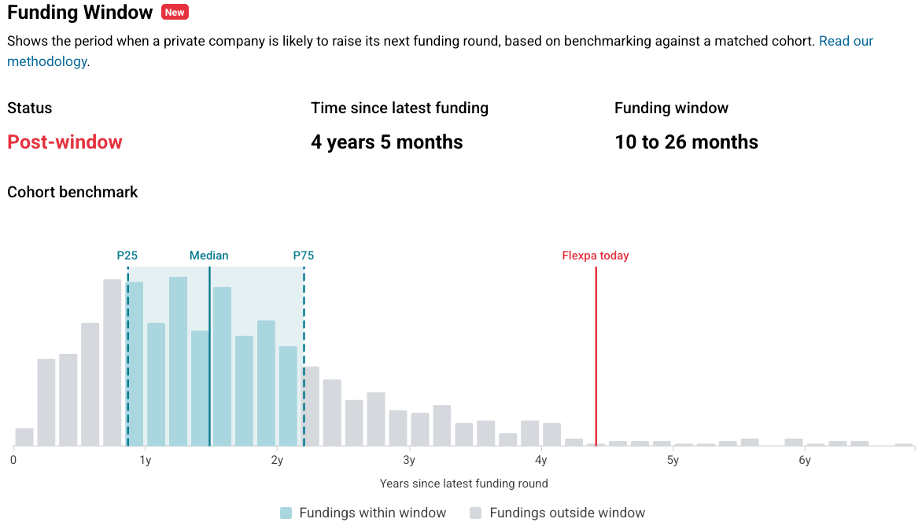
Flexpa’s funding window. Source: CB Insights
- Nabla makes an AI scribe used by clinicians in Europe and the US. Nabla is more of a long shot given its price.
- Why Nabla: Commure only began selling its ambient AI in the EU and UK in September. Nabla, based in Paris, would bring European customers and EHR integrations on day one, ahead of anything a new Commure sales team could build.
- Why it’s a long shot: It has raised $114M, including a $70M Series C in June 2025, and its headcount grew 69% in the past year. A company growing that fast has less reason to sell, and its product overlaps the ambient business Commure built on Augmedix. However, Nabla faces an uphill battle in taking market share, especially in the US, so it may be more open to a buyer with distribution.
How we built this
We used the CB Insights MCP to pull Commure’s acquisitions, business relationships, investments, hiring insights, funding, and news, and to check what rivals including R1 and Waystar have bought. We reviewed all 50 of Commure’s business relationships and its investment portfolio for candidates, then mapped the gaps in Commure’s system to CB Insights markets, including prior authorization, clinical coding, post-acute care, health data interoperability, and ambient AI, screened private, VC-backed startups that have raised under $150M, and ranked them by Mosaic score.
For information on reprint rights or other inquiries, please contact reprints@cbinsights.com.
If you aren’t already a client, sign up for a free trial to learn more about our platform.